


Larry Ellison helped bankroll a $3 million payout to 1 Michigan college football star — who tanked. Have NIL deals 'destroyed college football'?
Larry Ellison helped bankroll a $3 million payout to 1 Michigan college football star — who tanked. Have NIL deals 'destroyed college football'?

Mike CrisolagoTue, October 6, 2026 at 2:20 PM UTC
0
In 2024, Detroit native Bryce Underwood was considered the best high school quarterback in the nation.
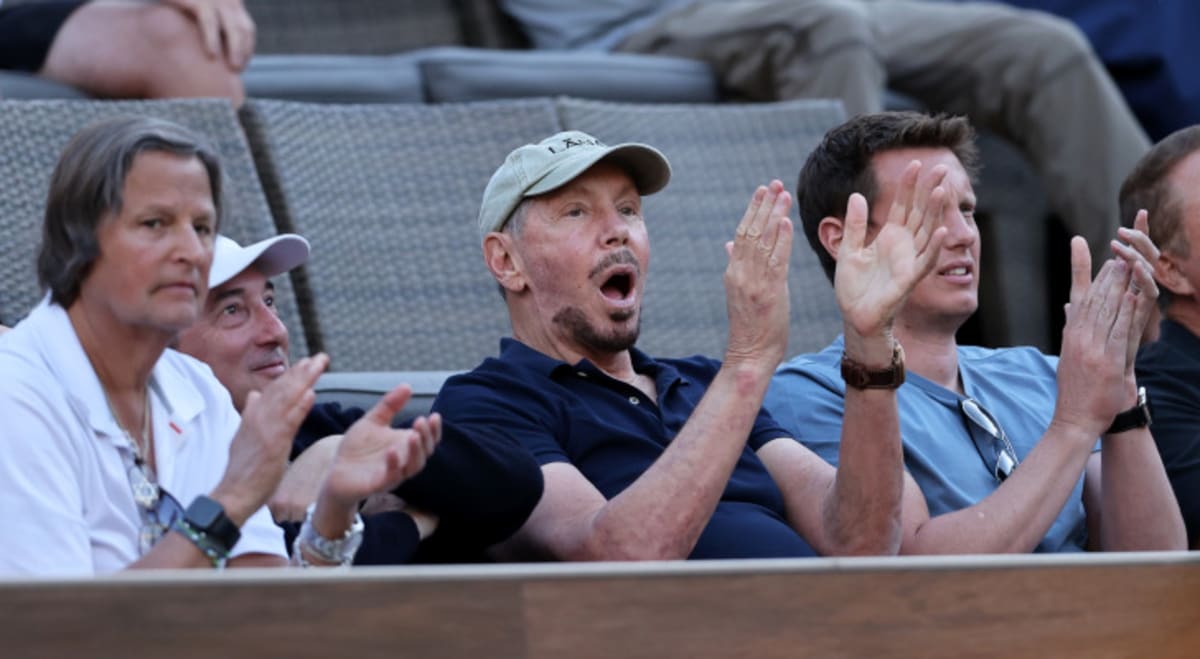
Not only were his home state Michigan Wolverines trying to recruit him, but billionaire Larry Ellison joined NFL great Tom Brady in the effort — even getting on a Zoom call with the 17-year-old, according to the Wall Street Journal (WSJ), to discuss his South Side Chicago childhood and explain that Underwood’s “birthplace didn’t determine his station in life, so long as he worked hard and made sacrifices.”
Must Read -
A single line on your car insurance policy could be inflating your premium by up to 30% — here's what to change
Dave Ramsey warns nearly 50% of Americans are making 1 big Social Security mistake. Here’s what it is and 3 simple steps to fix it ASAP
Jeff Bezos backs a platform that lets anyone invest in rental homes for as little as $100 — 6 ways to build wealth like a landlord without actually being one
Of course, it didn’t hurt that Ellison also contributed to a $3 million per year NIL (name, image and likeness) offer for Underwood to join the team. Underwood’s father even reportedly predicted that endorsement deals could net his son up to $15 million before he even graduated.
Two years into his college career, however, the sophomore hasn’t lived up to the hype. He struggled on the field last season and now, following a loss last weekend in which he overthrew a pass onto the sidelines to finish the game, the team’s playoff hopes hang in the balance. Some critics, meanwhile, blame his big money deal for holding back the entire team.
“This is where NIL has destroyed college football,” Ryan Ermanni, co-host of the Good Day Detroit morning show, posted on X. “The only reason Bryce Underwood is not on the bench right now is because of how much money he’s making.”
How NIL money complicated college football
NIL deals kicked off in 2021 as a way to let college athletes cash in on their name and branding.
As sports radio host Craig Carton recently explained on the Fox News Rundown podcast, “The concept of NIL, which is not what it is today, was that … if you bring in a million bucks off of my name, my image and my likeness, I should get a small piece of that.”
However, he added, the world of NIL deals became “the wild, wild west,” where schools can pay athletes “under the guise of name, image and likeness, but no one’s holding [them] accountable to do it … it’s just bags of cash.”
Carton also claimed that “boosters are funding” these college athletic programs
Boosters like Ellison, whose investment doesn’t seem to be panning out as he might have hoped. Neither Ellison nor the Wolverines returned Moneywise’s request for comment.
The WSJ pointed to other high-priced NIL college footballers, like LaNorris Sellers with the South Carolina Gamecocks, or John Mateer of the Oklahoma Sooners’ John Mateer — quarterbacks who make $2 million and $1.5 million per year respectively — whose under-performance this season has their coaches debating benching them.
In college football, where most players used to simply get a free education and a shot at the NFL in return for hitting the gridiron, it’s difficult to justify benching million-dollar talents — even if the team might be better off for it.
But that’s not the only area where NIL deals complicate the player/school relationship.
Advertisement
Take the case of the Duke Blue Devils, who settled a game-changing lawsuit with quarterback Darian Mensah earlier this year. Mensah — currently the highest-paid NIL college football player at $6.5 million a year — wasn’t tanking on the field.
But when he announced his desire to transfer to the University of Miami to play for the Hurricanes rather than wait out his Duke deal until the end of 2026, the school sued him.
The two parties eventually settled out of court and Mensah now plays for the Canes, but it exposed a deeper flaw in the NIL system — college football players are school students, not employees. So while a college may commit to paying a star athlete millions of dollars, they are not contractually obligated to the school in the way that an NFL player is to their franchise.
In theory, a player can transfer if they like, leaving the school little recourse for retaining their star athlete. The tradeoff is that the player likely loses whatever remains of their NIL deal and any endorsements that accompanied it.
That’s what happened with Kansas State’s Dylan Edwards, who quit the team with three games left in 2025. Not only did he forfeit his remaining NIL cash — an unspecified amount — but he had to return any vehicles from local endorsements with companies like Porsche and BMW too.
Read More: Here’s the average income of Americans by age in 2026. Are you keeping up or falling behind?
Tackling the NIL issue in Congress
The U.S. Congress is attempting to institute uniform NIL rules by pushing a bipartisan bill called The Protect College Sports Act. The bill, which was passed by the Senate at the end of September, would “create national standards around student athlete transfers, eligibility and compensation for name, image and likeness use,” according to Reuters.
The bill sets national rules for student transfers to new schools and higher compensation, while also requiring any NIL deal over $600 to be disclosed, among other rules.
Supporters of the bill include President Trump, along with an unlikely coalition of Republicans and some Democrats. The Washington Post, however, notes that opponents criticize the bill for circumventing established state laws, for not considering the interests of Black athletes and for punting on the issue of whether college athletes can be considered employees.
The Post quoted Democratic Sen. Chris Murphy as calling the bill a way “to protect a system of exploitation” while adding that he, along with fellow Democrats Bernie Sanders and Elizabeth Warren, have pushed legislation to classify college athletes as employees to “give them federal labor protections, including the right to unionize and negotiate over pay and working conditions.”
The Protect College Sports Act, however, still has to pass the House after the midterms — an outcome that is anything but some suggest could take a Hail Mary play to succeed.
What To Read Next -
Your Social Security ‘Trump Bump’ in 2027 will be one of the biggest in 25 years — but there’s a serious catch no one’s talking about
Dave Ramsey says this 1 indulgent purchase stops Americans from becoming wealthy. Here’s what he recommends instead
The tax breaks in Trump's 'big beautiful bill' expire after 2028. Here are 4 moves to make before the window closes
Your cash is rotting in a regular savings account. Here are 4 simple ways to grow your money (and no, you don't have to touch the stock market)
Get Warren Buffett's best investing lessons, free. Join 250,000 readers getting Moneywise’s sharpest money reporting every week. Subscribe and we’ll send you our guide to the ideas that built Buffett's fortune as a welcome gift.
This article provides information only and should not be construed as advice. It is provided without warranty of any kind.
Source: “AOL Sports”
