


Trilliant Health Releases Its 2026 Trends Shaping the Health Economy Report
Trilliant Health Releases Its 2026 Trends Shaping the Health Economy Report

Tue, October 6, 2026 at 10:02 AM UTC
0
BRENTWOOD, Tenn.--(BUSINESS WIRE)--Oct 6, 2026--
Trilliant Health, the healthcare industry’s leading analytics firm, today released its 2026 Trends Shaping the Health Economy Report, which examines how individually rational decisions across the health economy compound into collective failure.
This press release features multimedia. View the full release here: https://www.businesswire.com/news/home/20261006830657/en/
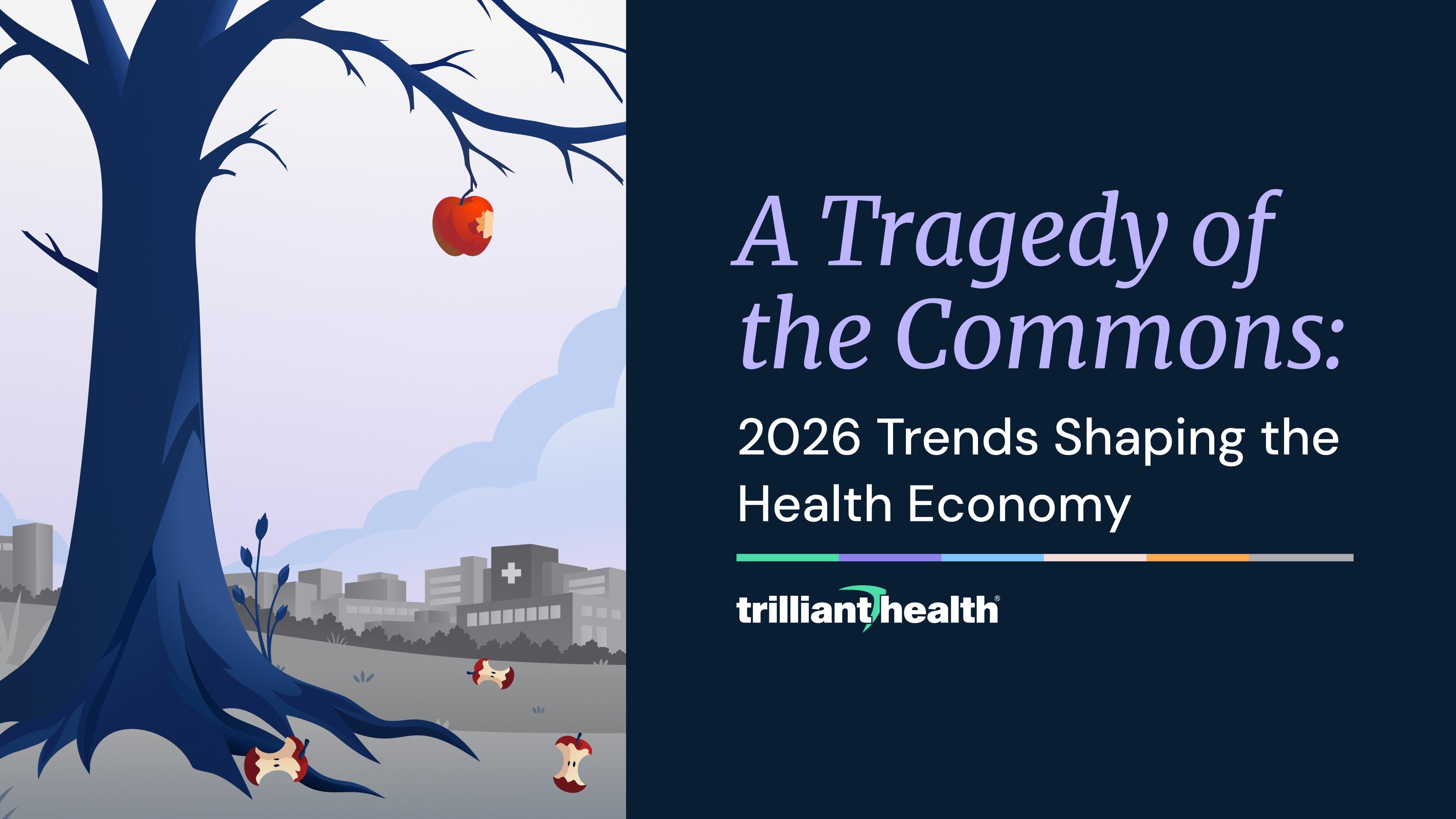
Trilliant Health's 2026 Trends Shaping the Health Economy Report finds the health economy is a textbook tragedy of the commons.
“The U.S. health economy is a textbook tragedy of the commons,” said Trilliant Health’s Chief Research Officer Allison Oakes, Ph.D. “Every stakeholder is incentivized to maximize its own revenue, and the predictable result is a healthcare system that delivers disproportionately little health for what it costs.”
The report examines this pattern across six trends, supported by hundreds of data stories drawn from Trilliant Health’s proprietary claims database, price transparency data and Provider Directory, alongside government and industry sources:
The U.S. healthcare “system” does not function as a system. The U.S. has never resolved three foundational questions: what is healthcare, who is entitled to it and who is obligated to pay? The lack of shared purpose impacts how care is financed, delivered and evaluated.
Concern about the healthcare system is widespread. As of 2025, 70% of Americans believe the healthcare system has major problems or is in a state of crisis (p. 13). Contributing to this, healthcare affordability has continued to erode, with employee deductibles and premiums (151.4%) increasing faster than wages (73.2%) and inflation (55.3%) (p. 19).
Population unwellness is a collective failure that the “system” is not designed to address. Poor diet, physical inactivity and social isolation are producing an increasingly unwell population, yet healthcare incentives remain focused on treating illness after it develops rather than preventing it.
Pediatric behavioral health visits and medication use are increasing. Between 2019 and 2025, pediatric visits for pervasive developmental disorders and anxiety disorders increased 117.1% and 72.4%, respectively (p. 34). Over the same period, the number of children receiving an SSRI (17.9%) or SNRI (13.6%) increased (p. 34). In 2025, 6.4% of children were using five or more medications (p. 39).
Opioid prescribing spans multiple providers for a substantial share of patients. In 2025, there were 11 states in which more than 10% of patients with an opioid prescription received hydrocodone or oxycodone prescriptions from three or more providers (p. 38).
The disconnect between demand and supply is a market failure. Utilization has remained relatively flat even as disease burden has increased, reflecting supply that is both constrained and misaligned with the needs of an increasingly unhealthy population.
Behavioral health and primary care physician supply falls short. By 2038, overall physician supply adequacy is projected to decline to 87.7%. Adult psychiatrists (49.8%) and primary care physicians (80.4%) are projected to be the most undersupplied (p. 48).
Advanced imaging and behavioral health utilization are growing faster than primary care. Between 2019 and 2025, advanced imaging visits per 1,000 grew at a compound annual growth rate of 4.9%, while outpatient behavioral health visits grew 4.8%. Primary care visits grew just 0.7% annually over the same period, while inpatient surgery decreased by 1.3% (p. 52).
Consumers are seeking non-traditional providers to fulfill demand that the healthcare system does not, will not or cannot. Those who proactively want to improve or maintain their health find the system has little to offer. In 2026, 49% of patients report administering a self-test for an illness or symptom, and 17% report requesting a lab test based on information learned from social media (p. 59).
Value is not incentivized; therefore, it is not measured or managed. The healthcare system generates enormous quantities of activity without a coherent framework for determining whether that activity produces any measurable health benefit.
Quality measurement emphasizes process over outcomes. CMS uses over 800 active quality measures, with just 27% directly tied to outcomes (p. 64). The absence of value measurement is not an oversight; it’s a structural feature of a fee-for-service system that monetizes volume rather than outcomes.
Price transparency data reveals that rates are not correlated with quality. The Los Angeles hospital with the highest negotiated rate for a heart attack ($63,622) has the fifth-highest mortality rate of the 41 hospitals analyzed. Across the four medical MS-DRGs for which hospitals are required to report post-discharge mortality, hospital-level negotiated rates and 30-day condition-specific mortality are weakly correlated (p. 65).
Misaligned incentives manifest in systemic fraud, waste and abuse. Every policy built to constrain American healthcare – site-of-service reimbursement differences, medical loss ratios, certificate of need laws, traditional fee-for-service reimbursement – has produced a workaround that is individually rational and collectively destructive.
For-profit hospice ownership is associated with longer stays and higher margins. From 2019 to 2024, the number of for-profit hospices grew 11.2% while nonprofit hospices shrank 2.0%. For-profit hospices posted a 13.7% Medicare margin in 2023, compared with -1.3% for nonprofits. Average lengths of stay were 120 days at for-profit hospices versus 71 days at nonprofits (p. 102).
Stakeholders fail to understand the health economy is a negative-sum game at their peril. The financial model of the U.S. healthcare system has long rested on a simple premise: more procedures, more patients, more revenue. New medications and shifts in settings of care are challenging this long-held belief.
Advertisement
Novel drugs are poised to replace surgical volume. Between 2019 and 2025, GLP-1 patient volume increased 719.7%, while bariatric surgery patient volume declined 32.4% (p. 123). Over the same period, SGLT2 inhibitor patient volume increased 247.7%, while cardiac catheterization patient volume declined 7.1%. These parallel trends raise questions about how medications may reshape future procedural demand (p. 123).
“American consumers seek value for money in almost every economic transaction, including healthcare, but health economy stakeholders are not delivering it,” said Hal Andrews, Chief Executive Officer of Trilliant Health. “Nature abhors a vacuum, and Federal and state government officials have concluded that price controls are the only way to control healthcare prices. Unless health economy stakeholders begin to act in the interest of the commons, they should expect to be increasingly constrained by outside forces.”
Read the report: https://www.trillianthealth.com/market-research/reports/2026-health-economy-trends
About Trilliant Health
Trilliant Health’s analytics platform provides a comprehensive view of healthcare supply, demand and yield across local markets. Recognizing that every American is affected by the health economy, its mission is to redefine evidence-based strategy while optimizing return on invested capital.
View source version on businesswire.com:https://www.businesswire.com/news/home/20261006830657/en/
media@trillianthealth.com
KEYWORD: UNITED STATES NORTH AMERICA TENNESSEE
INDUSTRY KEYWORD: OTHER HEALTH SOFTWARE MANAGED CARE GENERAL HEALTH PROFESSIONAL SERVICES DATA MANAGEMENT TECHNOLOGY HOSPITALS FITNESS & NUTRITION HEALTH INSURANCE INSURANCE HEALTH
SOURCE: Trilliant Health
Copyright Business Wire 2026.
PUB: 10/06/2026 06:00 AM/DISC: 10/06/2026 06:02 AM
http://www.businesswire.com/news/home/20261006830657/en
Source: “AOL Money”
